
The Xact EngineSM is a powerful calculation and analytics platform designed to deliver precise financial modeling across both hospital and physician contract management environments. By transforming static contract data into dynamic financial insights, it serves as the foundation for accurate reimbursement calculations and strategic decision-making. This engine empowers healthcare organizations to automatically detect payment variances, optimize pricing strategies, and model “what-if” scenarios for future contracts. With it’s deep analytical capabilities, providers gain the data-driven confidence needed to negotiate better terms and secure their revenue streams against leakage.


Boost Your Hospital’s Financial Health with Smarter Hospital Contract Management
Hospital contract management is a process of managing complex financial agreements between hospitals and payers to ensure the organization’s revenue integrity. It serves as the foundational element of the revenue cycle, translating intricate contract terms into precise, actionable financial data. This practice ensures accurate reimbursements, reduces administrative burden on staff, and provides the strategic insights needed to negotiate better terms and optimize overall revenue.

Unlock Financial Efficiency with Physician Contract Management
Physician contract management is the specialized process of overseeing and administering the complex agreements between medical practices and payers to ensure every professional service is reimbursed correctly according to intricate fee schedules. It acts as a critical financial safeguard, translating nuanced provider data and contract terms into a precise framework for revenue realization. By streamlining this complex workflow, medical groups can eliminate the administrative burden of manual data entry and focus their resources on patient care.

Take Control of Your Contracts with DocumentsAISM
DocumentsAISM transforms static contract documents into active, searchable assets, serving as an intelligent, centralized repository for all your payer agreements. It leverages artificial intelligence, organizes your contracts, and can analyze contract language across your portfolio. You will have the ability to instantly search for specific clauses, compare terms side-by-side across all contracts, and identify opportunities for standardization. This empowers both hospital and physician organizations to prevent revenue leakage from underpayments, denials, write-offs, and more caused by outdated terms and gives you the ability to negotiate more effectively.
The Power of Analytics in Transforming Revenue Cycles
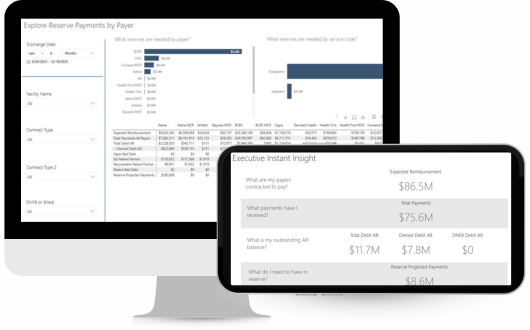
Our analytics solution transforms vast amounts of billing, claims, and payment data into a clear, comprehensive view of a healthcare organization’s financial performance and opportunity. It provides the essential intelligence needed to diagnose issues, track key performance indicators, and understand the health of the entire revenue cycle from patient registration to final payment. Our advanced analytics suite provides a comprehensive, 360-degree view of financial performance, offering executive leadership tools like dashboards, payor insights, revenue analysis, and pricing optimization to empower smarter revenue cycle management and secure your hospital’s financial future.
Best Practices for Contract Management
- Ensure Data Accuracy: Always load contracts with precision to avoid errors in reimbursement calculations. Use tools like the Xact EngineSM to model contracts accurately and detect variances. Providing your partner with all relevant documentation, feed schedules, and any important information around your contracts can ensure you get ahead of missing information down the road.
- Leverage Advanced Analytics: Utilize RCM Analytics to gain actionable insights into financial performance, track key metrics, and identify areas for improvement in your revenue cycle.
- Centralize Contract Storage: Use solutions like DocumentsAISM to transform static contracts into searchable, centralized assets. This allows for quick access, comparison, and standardization of terms across agreements.
- Regularly Review and Update Contracts: Prevent revenue leakage through underpayments and denials by identifying outdated terms and renegotiating payer agreements to align with current market conditions.
- Unburden Staff with Expert Support: Delegate the complex task of contract loading and management to specialists, freeing up your team to focus on high-value activities like patient care and denial resolution.
- Optimize Pricing Strategies: Use analytics to develop strategic pricing that balances competitive positioning with reimbursement realities. Evaluate how your charges compare to contracted rates across different payer mixes to inform negotiation strategies and identify opportunities for rate improvements.
- Customize Reporting: Tailor reports to meet the specific needs of your organization, whether for executive dashboards, provider-level insights, or location-based performance analysis.
These practices help ensure that your contract management processes are efficient, accurate, and aligned with your financial goals. Let me know if you’d like to expand on any of these!
Frequently Asked Questions (FAQs) about Contract Management
- How can analytics improve contract management? Analytics provides actionable insights into performance, payment trends, and reimbursement rates. By leveraging data, organizations can evaluate contract performance, negotiate better terms, and ensure strategies are aligned with financial objectives.
- What tools are essential for effective contract management? Comprehensive contract management tools should include features like automated workflows, document storage, reporting capabilities, and integration with financial and operational systems. These tools streamline processes and improve accuracy.
- Can contract management practices be customized for different organizational needs? Yes, the best practices for contract management can and should be tailored to each organization’s unique structure, goals, and operational needs. Custom reporting and workflows are often essential for achieving optimal outcomes.
- How is Payment Accuracy Calculated? The expected reimbursement calculation is the bedrock for how we calculate payment accuracy. We calculate the expected reimbursement by loading your contract based on provided contract documentation (ex. fee schedules, payment hierarchy, payer policies, etc.) We take this expected reimbursement calculation and compare it to total payer payments to see how well we match up.